

Character 生
生
Translation
- (v.) have a baby, give birth to; grow; come into existence; beget; light (fire)
- (n.) The lead (refers to the main male role in Beijing opera. This role has numerous subtypes)
- (adj.) new, unfamiliar, strange
- (adj./adv.) raw; uncooked; unprocessed; unfamiliar; just, simply; very
- (radical.) life
- (char.) scholar; pupil, student; people taking up certain jobs as their occupation
Radical
Simplified
生
Traditional
生
Strokes count
5
Words with 生 73
Writing and worksheets
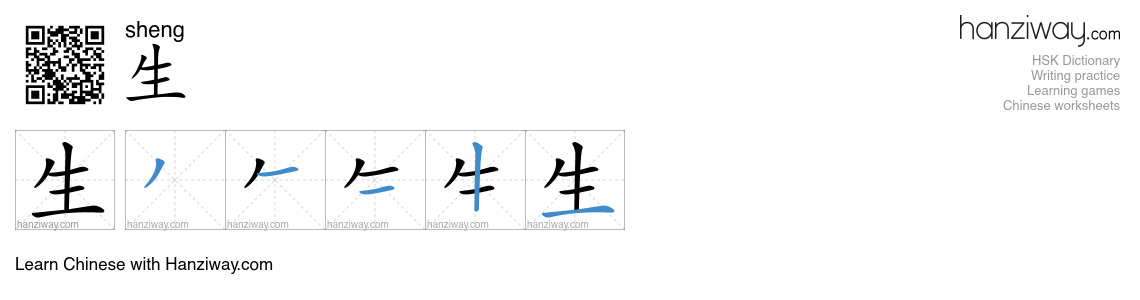
Stroke order
Games & Exercises 9
Find Hanzi
Find Hanzi is a playful exercise for learning Chinese. Spot characters, boost attention, download PDF, and enjoy studying Chinese through games!
Find Radical
Practice Chinese radicals online: choose the Hanzi containing the target component, use optional pinyin hints, and create printable PDF exercises.
Tone Trainer
Learn Mandarin tones online with the Chinese Tone Trainer. Practice tone recognition, pronunciation, and exercises for beginners and advanced learners.
Hanzi Connect
Match Hanzi with pinyin or identify words by sound. Use your own vocabulary or HSK/YCT levels. Play online after sign-in; printable PDFs with answers are for PRO.
Lost Stroke
Play online: find the missing stroke or radical, restore Chinese characters in order, and create printable PDF worksheets with pinyin and answers.
Calligraphy
Create calligraphy and custom Chinese character coloring pages with pinyin, stroke order, outline styles, and writing grids. Download a print-ready PDF for class or home.
Memo
Flip cards to match Chinese characters or pair Hanzi with Pinyin. Build a custom HSK/YCT deck, play online, and create printable PDF cards.
Sudoku
Play Hanzi Sudoku online with 4×4, 6×6, or 9×9 grids, four difficulty levels, custom characters, and HSK/YCT sets. Create printable PDFs with answers.
Writing trainer
Practice Chinese character writing online with correct stroke order, outlines, a 3–2–1 preview, mistake-based hints, pinyin, and focused Hanzi review.







Examples of use 23
生
日
(n.) birthday
出
生
(v.) be born
产
生
(v.) bring forth, produce, arise
生
长
(v.) (of plants) to grow; (of a person) to be born and brought up
李
先
生
是
坐
出
租
车
去
饭
店
的
吗
?
Does Mr. Li go to the hotel by taxi?
女
士
们
,
先
生
们
,
大
家
晚
上
好
!
Good evening, ladies and gentlemen!
中
国
的
学
生
一
年
有
两
个
长
的
假
期
,
一
个
在
夏
天
,
一
个
在
冬
天
。
Chinese students have two long holidays a year, one in summer and one in winter.
他
是
舞
蹈
专
业
的
学
生
。
He is a dance major.
王
先
生
的
工
作
很
忙
。
Mr. Wang is very busy with his work.
老
师
的
学
生
来
信
了
,
她
很
高
兴
。
She was glad to hear from the teacher's students.
我
的
学
校
一
共
有
一
千
两
百
个
学
生
。
There are twelve hundred students in my school.
球
场
上
有
很
多
学
生
在
玩
球
。
There are many students playing ball on the court.
我
们
有
一
百
零
五
个
学
生
。
We have 105 students.
我
们
学
校
有
一
万
个
学
生
。
There are ten thousand students in our school.
白
先
生
,
你
好
!
Hello, Mr. Bai!
王
先
生
这
几
天
没
有
出
现
。
Mr. Wang hasn't appeared these days.
你
看
见
张
先
生
了
吗
?
Have you seen Mr Zhang?
这
位
先
生
,
请
问
你
找
谁
?
This gentleman, who are you looking for?
学
生
们
每
个
人
都
有
运
动
服
。
Each of the students has sportswear.
学
生
们
每
天
早
上
在
操
场
上
做
运
动
。
The students do sports on the playground every morning.
学
生
们
在
看
手
机
。
The students are looking at their mobile phones.
生
火
to make a fire; to light a fire
生
词
new word (in textbook) | word that is unfamiliar or not yet studied | CL:組|组[zu3],個|个[ge4]