

种
Character 和
和
TOP-50
Frequency
The ranking is based on data from open sources.
Translation
- (conj.) and
- (adj./v./n.) harmonious, friendly; to draw or tie, make peace; (referring to) Japan
- (n./prep.) sum; with
- (v.) to mix or blend (after adding a liquid to powders/granules)
- (v.) to mix and make it sticky (after adding a liquid to powders), to knead (a dough)
- (v.) join in the singing; echo what others say
- (v.) to win (a mah-jong or card game)
Radical
Simplified
和
Traditional
和
Strokes count
8
Words with 和 22
Writing and worksheets
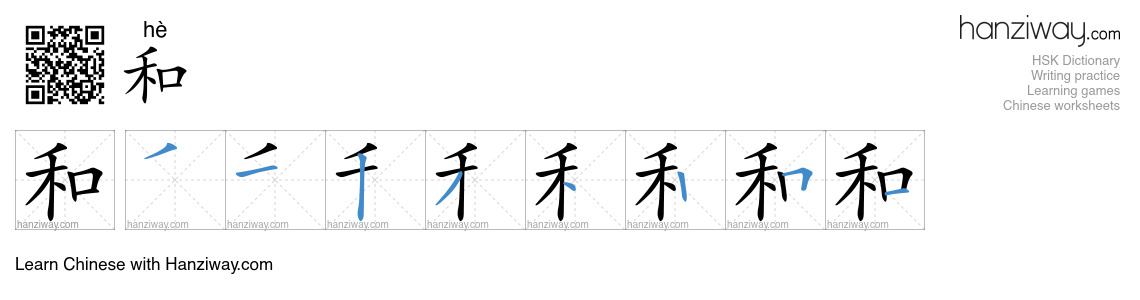
Stroke order
Games & Exercises 9
Find Hanzi
Find Hanzi is a playful exercise for learning Chinese. Spot characters, boost attention, download PDF, and enjoy studying Chinese through games!
Find Radical
Practice Chinese radicals online: choose the Hanzi containing the target component, use optional pinyin hints, and create printable PDF exercises.
Tone Trainer
Learn Mandarin tones online with the Chinese Tone Trainer. Practice tone recognition, pronunciation, and exercises for beginners and advanced learners.
Hanzi Connect
Match Hanzi with pinyin or identify words by sound. Use your own vocabulary or HSK/YCT levels. Play online after sign-in; printable PDFs with answers are for PRO.
Lost Stroke
Play online: find the missing stroke or radical, restore Chinese characters in order, and create printable PDF worksheets with pinyin and answers.
Calligraphy
Create calligraphy and custom Chinese character coloring pages with pinyin, stroke order, outline styles, and writing grids. Download a print-ready PDF for class or home.
Memo
Flip cards to match Chinese characters or pair Hanzi with Pinyin. Build a custom HSK/YCT deck, play online, and create printable PDF cards.
Sudoku
Play Hanzi Sudoku online with 4×4, 6×6, or 9×9 grids, four difficulty levels, custom characters, and HSK/YCT sets. Create printable PDFs with answers.
Writing trainer
Practice Chinese character writing online with correct stroke order, outlines, a 3–2–1 preview, mistake-based hints, pinyin, and focused Hanzi review.






Examples of use 22
这
次
考
试
我
的
成
绩
不
高
,
都
怪
我
太
不
仔
细
了
,
把
师
和
帅
都
写
错
了
。
My grade for this exam wasn't high, which was due to my carelessness. I wrote both teacher and handsome wrong.
由
于
这
个
大
学
越
来
越
有
名
,
中
国
学
生
和
外
国
留
学
生
的
数
量
都
在
增
加
。
As the university becomes more and more famous, the number of Chinese students and foreign students is increasing.
节
约
和
浪
费
这
两
个
词
的
意
思
是
相
反
的
。
The words economy and waste have opposite meanings.
这
里
附
近
不
但
有
美
术
展
览
,
而
且
有
电
影
院
和
图
书
馆
。
There is not only an art exhibition nearby here, but also a cinema and library.
这
个
房
间
好
暖
和
!
This room is so warm!
由
于
人
们
在
一
周
内
的
营
养
摄
入
和
饮
食
模
式
会
影
响
到
他
们
的
体
重
变
化
,
因
此
节
食
者
的
体
重
会
在
一
周
内
上
下
波
动
。
Because people's nutrient intake and diet patterns will affect their weight changes during the week, dieters' weight will fluctuate up and down during the week.
在
和
别
人
对
话
时
,
你
应
该
看
着
别
人
,
这
是
一
种
礼
貌
。
When talking with others, you should look at the other person. This is a way to show courtesy.
我
和
你
me and you
我
和
老
公
对
视
一
眼
,
这
么
小
的
孩
子
怎
么
学
会
了
背
后
议
论
人
。
My husband and I looked at each other. How did such a small child learn to talk about people behind his back?
人
同
时
具
有
了
坚
定
的
意
志
力
和
敏
锐
的
判
断
力
,
这
就
是
成
长
。
People have firm willpower and keen judgment at the same time, which is growth.
这
种
状
态
如
果
持
续
数
天
、
数
周
、
数
月
,
将
导
致
高
血
压
、
失
眠
和
一
些
精
神
问
题
等
。
If this state lasts for several days, weeks and months, it will lead to high blood pressure, insomnia and some mental problems.
他
们
在
讨
论
旅
行
的
计
划
和
安
排
。
They are discussing plans and arrangements of the travel.
我
喜
欢
打
篮
球
和
跑
步
。
I like playing basketball and jogging.
这
是
我
的
护
照
和
签
证
。
Here is my passport and visa.
铜
和
铁
都
是
金
属
。
Copper and iron are metals.
我
有
一
个
姐
姐
和
一
个
弟
弟
。
I have one elder sister and one younger brother.
"
那
里
"
和
"
那
儿
"
的
意
思
差
不
多
。
The meanings of "na li" and "nar" are almost the same.
“
这
里
”
和
“
这
儿
”
的
意
思
差
不
多
。
The meanings of "zhe li" and "zher" are almost the same.
“
早
上
”
和
“
上
午
”
的
意
思
不
一
样
。
The meanings of "Zaoshang (the time period between sunrise and 8 or 9am)" and "Shangwu (the time period before 12nn)" are different.
“
每
天
”
和
“
天
天
”
的
意
思
不
完
全
一
样
。
The meanings of "mei tian" and "tiantian" are not entirely the same.
桌
子
和
椅
子
table and chair
她
学
习
中
文
和
英
语
。
She is studying Chinese and English.