

交
Word 文 - HSK 7-9
文
Translation
- (n./m./v.) liberal arts, humanities; (used in old times for) copper cash; to tattoo
- (radical.) written language
- (char.) script; written language; article; literary language; culture; etiquette; civil; refined; certain natural phenomenon; cover over (mistakes)
Simplified
文
Traditional
文
Strokes count
4

Words with 文 24
Same pronunciation 10
Similar pronunciation 26
Synonyms 12
Writing and worksheets
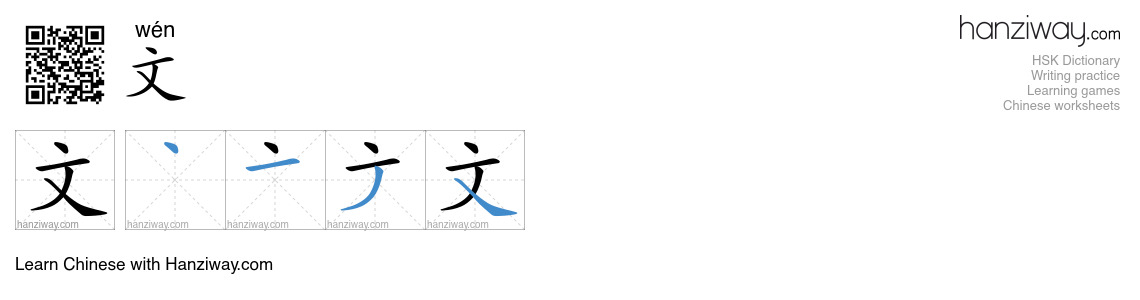
Stroke order
Games & Exercises 9
Find Hanzi
Find Hanzi is a playful exercise for learning Chinese. Spot characters, boost attention, download PDF, and enjoy studying Chinese through games!
Find Radical
Practice Chinese radicals online: choose the Hanzi containing the target component, use optional pinyin hints, and create printable PDF exercises.
Tone Trainer
Learn Mandarin tones online with the Chinese Tone Trainer. Practice tone recognition, pronunciation, and exercises for beginners and advanced learners.
Hanzi Connect
Match Hanzi with pinyin or identify words by sound. Use your own vocabulary or HSK/YCT levels. Play online after sign-in; printable PDFs with answers are for PRO.
Lost Stroke
Play online: find the missing stroke or radical, restore Chinese characters in order, and create printable PDF worksheets with pinyin and answers.
Calligraphy
Create calligraphy and custom Chinese character coloring pages with pinyin, stroke order, outline styles, and writing grids. Download a print-ready PDF for class or home.
Memo
Flip cards to match Chinese characters or pair Hanzi with Pinyin. Build a custom HSK/YCT deck, play online, and create printable PDF cards.
Sudoku
Play Hanzi Sudoku online with 4×4, 6×6, or 9×9 grids, four difficulty levels, custom characters, and HSK/YCT sets. Create printable PDFs with answers.
Writing trainer
Practice Chinese character writing online with correct stroke order, outlines, a 3–2–1 preview, mistake-based hints, pinyin, and focused Hanzi review.








Examples of use 44
据
说
,
曾
经
有
一
位
很
有
个
性
、
极
爱
冒
险
的
大
导
演
到
南
美
丛
林
拍
有
关
古
代
印
加
文
明
的
纪
录
片
。
It is said that there was once a great director with great personality and adventure who went to the jungles of South America to make a documentary about ancient Inca civilization.
桌
子
上
有
一
本
最
新
的
中
文
杂
志
。
There is a new Chinese magazine on the desk.
看
了
这
本
书
以
后
,
我
对
中
国
的
文
化
了
解
了
很
多
。
After reading this book, I learned a lot about Chinese culture.
但
是
他
遗
憾
地
发
现
,
几
乎
没
有
一
本
英
文
书
能
充
分
解
释
汉
字
的
字
源
。
However, he regretted to find that almost no English book can fully explain the etymology of Chinese characters.
我
认
识
的
中
文
字
不
多
,
所
以
读
中
文
报
纸
的
话
会
有
点
困
难
。
I don't know many Chinese characters, so it will be a little difficult to read Chinese newspapers.
我
的
中
文
听
力
不
太
好
。
My Chinese listening is not very good.
请
大
家
把
作
文
上
载
到
这
个
网
站
上
。
Please upload your composition to this website.
建
伟
在
大
学
的
一
座
公
寓
楼
里
开
了
一
家
书
店
,
顺
便
卖
点
儿
文
具
、
电
池
、
小
日
用
品
等
。
Jianwei opened a bookstore in an apartment building of the university, selling stationery, batteries and small daily necessities by the way.
你
的
中
文
学
得
怎
样
?
How are you getting on with Chinese?
我
对
中
国
的
文
化
和
语
言
很
感
兴
趣
。
I am very interested in Chinese culture and language.
济
南
的
泉
水
,
历
史
悠
久
,
最
早
的
文
字
记
载
可
以
推
到
3
0
0
0
多
年
前
。
The spring water in Jinan has a long history, and the earliest written records can be pushed back to more than 3,000 years ago.
这
篇
文
章
的
作
者
是
一
个
非
常
著
名
的
作
家
。
The author of this article is a very famous writer.
我
的
朋
友
是
法
国
人
,
他
会
说
一
点
儿
中
文
。
My friend is French. He can speak a little Chinese.
你
的
中
文
说
得
真
好
!
You speak Chinese really well!
中
文
是
我
最
喜
欢
的
语
言
!
Chinese is my favorite language!
他
的
中
文
学
好
了
,
他
的
自
信
心
也
有
了
。
His Chinese is better, and his self-confidence is better.
中
国
的
文
化
很
有
意
思
。
Chinese culture is very interesting.
你
和
我
女
儿
一
样
,
斯
斯
文
文
的
,
一
看
就
读
过
书
,
心
眼
儿
好
。
You, like my daughter, are gentle. You have read books and have a good heart.
中
文
的
语
法
很
难
。
The grammar of Chinese is very difficult.
来
中
国
后
,
我
的
中
文
水
平
提
高
得
很
快
!
After coming to China, my Chinese level has improved rapidly!
小
学
的
课
包
括
语
文
、
数
学
。
Classes in primary schools include Chinese and mathematics.
虽
然
中
文
写
字
有
点
难
,
但
是
汉
字
非
常
有
趣
!
Although writing in Chinese is a bit difficult, Chinese characters are very interesting!
你
在
中
国
,
至
少
要
会
说
一
点
儿
中
文
。
When you are in China, you should speak at least a little Chinese.
学
校
每
年
都
会
举
办
中
国
文
化
节
。
The school holds Chinese Culture Festival every year.
我
有
三
个
外
国
朋
友
,
他
们
都
会
说
中
文
。
I have three foreign friends, all of whom speak Chinese.
你
中
文
学
了
多
久
了
?
How long have you been learning Chinese?
他
来
中
国
后
,
学
了
很
多
中
文
。
He has learned a lot of Chinese since he came to China.
我
在
学
校
学
中
文
和
法
语
。
I study Chinese and French at school.
她
又
要
英
文
又
要
学
中
文
,
很
忙
。
She needs both English and Chinese, so she is very busy.
她
又
要
学
英
文
又
要
学
中
文
,
很
忙
。
She has to learn both English and Chinese, so she is very busy.
我
觉
得
会
说
中
文
很
酷
。
I think it's cool to speak Chinese.
学
校
门
口
新
开
了
一
家
文
具
店
。
A new stationery store has opened at the school gate.
我
学
中
文
学
了
一
年
了
。
I have studied Chinese for a year.
你
喜
欢
中
国
文
学
吗
?
Do you like Chinese literature?
你
这
个
学
期
学
中
文
吗
?
Are you learning Chinese this term?
你
觉
得
中
文
难
学
吗
?
Do you find Chinese difficult to learn?
我
想
买
一
些
中
文
书
。
I want to buy some Chinese books.
你
为
什
么
要
学
中
文
?
Why do you want to learn Chinese?
请
说
中
文
。
Please speak Chinese.
他
为
什
么
学
中
文
?
Why does he learn Chinese?
他
们
在
一
起
学
课
文
。
They study the text together.
他
在
学
中
文
,
因
为
他
喜
欢
学
汉
字
。
He is learning Chinese because he likes learning Chinese characters.
我
在
听
中
文
课
文
录
音
。
I'm listening to the recording of the Chinese text.
学
中
文
真
有
意
思
!
Learning Chinese is really interesting!